New employer SUI (SUTA) rates by state: 2026 rates for 50 states and DC, and the four states that have set 2027
In 2026 a new employer's state unemployment insurance (SUI, also called SUTA) rate runs from 1.00% in states such as Alaska, Delaware, Idaho, Iowa and North Carolina to 4.1% in New York, where the state adds a 0.075% Re-employment Service Fund charge to a 4.025% UI rate. As of October 17, 2026, four states have published a 2027 new-employer rate: Colorado (1.70%, down from 3.05% because its solvency surcharge ends), Oklahoma (1.5%), Pennsylvania (3.822%) and Wisconsin (3.05%, or 3.25% for payrolls of $500,000 or more).
- Lowest standard 2026 rate
- 1.00% (Alaska employer share, Delaware, Idaho, Iowa, North Carolina, North Dakota, Rhode Island, Vermont, and others)
- Highest standard 2026 rate
- New York 4.1% (4.025% UI + 0.075% RSF)
- States with a published 2027 new-employer rate
- 4 (Colorado, Oklahoma, Pennsylvania, Wisconsin)
- Largest 2027 change so far
- Colorado non-construction: 3.05% in 2026 to 1.70% in 2027
- Highest stated new construction rate
- North Dakota 9.67% (2026)
- Delaware from January 1, 2027
- New employers first liable on or after that date pay 1% plus an industry assessment of 0.00% to 0.75%, plus a 0.175% operations and technology assessment (19 Del. C. 3348(o), 3350B, 3350E)
Figures above were read from each state's own agency page, rate notice or statute on 2026-10-16 and 2026-10-17. See sources.
How to read the table
Most states give every new employer the same rate until the employer has enough history for an experience rate. Some states set the rate by industry instead (Louisiana, Minnesota, Montana, New Mexico, Utah, Washington, Wyoming), and many set a higher rate for new construction employers.
States also charge add-ons with different names: administrative fees, training taxes, solvency surcharges, support rates. Where a state lists an add-on separately, the table shows it in its own column and does not add it to the rate. Where the state itself publishes a combined total (Colorado, Georgia, Maine, New York, Ohio, South Carolina), the table shows that total and its parts as the state gives them.
Taxable wage bases for 2026 and 2027 are in the second table and on our page on 2027 SUI taxable wage bases by state.
New employer SUI rates by state, 2026 and 2027
| State | 2026 new-employer rate | Construction or industry rates | Add-ons the state lists separately | 2027 | Source |
|---|---|---|---|---|---|
| Alabama | 2.70% | none stated | none stated on the page | not announced as of 2026-10-17 | Workforce Alabama FAQ, "What is the new account rate?" (page dated Nov. 16, 2023; no year stated) |
| Alaska | 1.00% employer | 1.00% in every NAICS sector | 0.50% employee contribution withheld from wages (total 1.50%) | not announced as of 2026-10-17 | Alaska DOLWD, 2026 rates for new (industry) employers |
| Arizona | 2.0% (statute) | none stated | not confirmed | not announced as of 2026-10-17 | A.R.S. 23-729 (DES pages returned HTTP 403) |
| Arkansas | 2026 not confirmed; the DWS contributions page lists 2.0% for 2025 (1.9% plus a 0.1% administrative assessment) | none stated | administrative assessment of 0.1% for fiscal year 2025 (DWS) | not announced as of 2026-10-17 | Arkansas DWS, Employer UI Contributions; DWS 2023 employer newsletter |
| California | 3.4% | none stated | Employment Training Tax 0.1% | not announced as of 2026-10-17 | EDD, California Employer's Guide DE 44 (2026) |
| Colorado | 3.05% combined (1.53% + 0.17% support + 1.35% solvency surcharge) | Heavy construction 6.285% (4.28% + 0.48% + 1.525%); general construction and trades 3.05% | support rate and surcharge are part of the combined rate the state gives | 1.70% (1.53% + 0.17%, no surcharge); heavy construction 4.06% | CDLE, Introductory Rates |
| Connecticut | 1.9% | none stated | fund solvency tax rate 1.0% (the page does not say whether the 1.9% includes it) | not announced as of 2026-10-17 | CTDOL, tax rate for calendar year 2026 |
| Delaware | 1.0% | New construction 1.0% | none for new employers in 2026 (the 0.2% operations and technology assessment applies to rated employers) | For employers first liable on or after Jan. 1, 2027: 1% + industry assessment 0.00% to 0.75% + 0.175% operations and technology assessment | Delaware DOL, Merit Rate Table; 19 Del. C. 3302, 3348, 3350B, 3350E |
| District of Columbia | 2.7%, or the average rate of all employers if higher | construction gets the same rate | administrative funding assessment 0.2% | not announced as of 2026-10-17 | DOES, Tax Rate Questions; D.C. Code 51-103 |
| Florida | 2.7% | none stated | none stated | not announced as of 2026-10-17 | Florida Department of Revenue, reemployment tax rate information |
| Georgia | 2.70% total | none stated | the department gives one total rate | not announced as of 2026-10-17 | Georgia DOL, employer FAQs |
| Hawaii | 2.40% | none stated | Employment and Training (E&T) rate 0.01% | not announced as of 2026-10-17 | Hawaii DLIR, tax rate schedule |
| Idaho | 1.000% standard rate (0.97% UI + 0.03% workforce development; administrative 0.00%) | none stated | the state shows the parts inside the 1.000% | not announced as of 2026-10-17 | Idaho DOL, 2026 rate class array |
| Illinois | 3.350% (includes the 0.550% fund building rate) | Administrative and support and waste management (NAICS 56) 3.450% | fund building rate is included in the entry rate | not announced as of 2026-10-17 | IDES, EA-50 (11/2025) |
| Indiana | 2.5% | Construction: "2.5%, The lesser of 4.0 or the average rate for all construction companies"; government 1.6% | none stated | not announced as of 2026-10-17 | Indiana DWD, New Employer Premium Rate (no year stated) |
| Iowa | 1.000% | Construction 5.400% | none stated | not announced as of 2026-10-17 | Iowa Workforce Development, employer handbook |
| Kansas | 1.75% | Construction 5.55% | not confirmed | not announced as of 2026-10-17 | Kansas Legislative Research Department, Aug. 25, 2026 (dol.ks.gov returned HTTP 403) |
| Kentucky | 2.7% | Construction: highest rate on the schedule in effect (Schedule A in 2026, top rate 9.00%) | SCUF 0.0% in 2026; the guide says SCUF is a share of the tax, not an added cost | rate not announced; SCUF set at 0.0115% for 2027 by SB 129 | Kentucky OUI, Employer Guide 2026 |
| Louisiana | weighted average rate of the employer's two-digit NAICS industry, not less than 1% (statute) | by industry; 2026 industry rates not confirmed | not confirmed | not announced as of 2026-10-17 | La. R.S. 23:1535 (the agency site disallows automated reading) |
| Maine | 2.54% combined (2.23% + CSSF 0.14% + UPAF 0.17%) | none stated | CSSF and UPAF are part of the combined rate the state gives | not announced as of 2026-10-17 | Maine DOL, 2026 rate category array |
| Maryland | ranges from 1.0% to 2.6% | Foreign construction contractors: Maryland construction average, not below the new employer rate | none stated | not announced as of 2026-10-17 | Maryland Department of Labor, tax rates |
| Massachusetts | 2.42% (employers registered less than 3 years) | 6.08% for new construction industry employers | COVID-19 Recovery Assessment listed separately by DUA (rate for new employers not confirmed) | not announced as of 2026-10-17 | Mass. DUA, Employer contributions to unemployment; M.G.L. c. 151A, section 14 |
| Michigan | 2.7% plus one-third of the employer's chargeable benefits component in year 1 | Construction: average construction contractor rate plus the same component | none stated | not announced as of 2026-10-17 | MCL 421.19(1), Tables A-2 and B-2; UIA FAQ |
| Minnesota | by industry: 1.00% to 4.06% (mining) for non-construction | Construction 1.98% to 8.90% by five-digit NAICS | base tax rate 0.40% added to the rate; additional assessment of 14.00% of the tax | not announced as of 2026-10-17 | Minnesota UI, 2026 new employer rates and tax rate factors |
| Mississippi | 1.0% year 1, 1.1% year 2, 1.2% year 3 and later | none stated | Workforce Investment and Training Contribution not included (rate not on the page) | not announced as of 2026-10-17 | MDES, employer FAQs |
| Missouri | 2.376% (includes the contribution rate adjustment) | Mining and construction 2.376%; 501(c)(3) nonprofits 1.00% | contribution rate adjustment is included | not announced as of 2026-10-17 | Missouri DES, tax rates |
| Montana | by industry: 1.00% to 2.00% | Construction 2.00%; agriculture and mining 1.30%; services 1.10%; unclassified 2.00% | Administrative Fund Tax 0.18% | not announced as of 2026-10-17 | Montana DLI, 2026 rate explanation |
| Nebraska | 1.25% | Construction 5.40% | SUIT allocation (20.0% of the combined tax) is part of the combined rate | not announced as of 2026-10-17 | Nebraska DOL, combined tax rates (revised Dec. 2, 2025) |
| Nevada | 2.95% (statute) | none stated | 0.05% for the employment and training program (NRS 612.606) | not announced as of 2026-10-17 | NRS 612.540 and 612.606 (DETR pages returned HTTP 403) |
| New Hampshire | 2.7% less the quarterly Trust Fund Reduction; NHES lists a 1.00% reduction for the first and second quarters of 2026 (net 1.7%); later 2026 quarters not listed as of 2026-10-17 | none stated | administrative contribution equal to 2/5 of 1% carved from each rate (RSA 282-A:87, IV) | not announced as of 2026-10-17 | NHES Tax Rate FAQs and Tax Rate Chart; RSA 282-A:81, 82, 87 |
| New Jersey | 2.6825% UI (rate year July 1, 2026 to June 30, 2027) | none stated | Workforce/Supplemental Workforce Funds 0.1175%; employer disability insurance 0.50% | 2.6825% through June 30, 2027 (rates are set by fiscal year) | NJDOL, rate information |
| New Mexico | greater of the industry average or 1%: 1.00% in most sectors, up to 1.28% | Construction 1.21% | none stated | not announced as of 2026-10-17 | NMDWS, how UI tax rates are calculated |
| New York | 4.1% total (4.025% UI, of which 3.4% is the normal rate, + 0.075% RSF) | none stated | Re-employment Service Fund 0.075% | not announced as of 2026-10-17 | NYSDOL, unemployment insurance rate information |
| North Carolina | 1.000% | none stated | none stated | not announced as of 2026-10-17 | NC DES, tax rate information |
| North Dakota | 1.00% (positive balance), 6.07% (negative balance) | Construction 9.67% | none stated | not announced as of 2026-10-17 | Job Service North Dakota, 2026 rate schedules |
| Ohio | 2.85% (2.7% + 0.15% technology and customer service fee) | Construction 5.85% (5.7% + 0.15%) | technology and customer service fee 0.15% | not announced as of 2026-10-17 | ODJFS, 2026 rate details |
| Oklahoma | 1.5% | none stated | none stated | 1.5% | OESC, Important Numbers for 2026 and 2027 |
| Oregon | 2.4% | none stated | none stated | not announced as of 2026-10-17 | Oregon Employment Department, release of Nov. 18, 2025 |
| Pennsylvania | 3.822% (includes the 9.2% surcharge) | Construction 10.5924% | 0.60% additional contributions tax does not apply to newly liable employers; employee withholding 0.07% of gross wages | 3.822%; construction 10.5924% | PA Department of Labor and Industry, Yearly Tax Highlights |
| Rhode Island | 1.00% | none stated | Job Development Fund 0.21% | not announced as of 2026-10-17 | RI DLT, Employer Tax Unit |
| South Carolina | 1.060% total (1.000% + 0.060% contingency assessment) | none stated | Departmental Administrative Contingency Assessment 0.06% | not announced as of 2026-10-17 | SC DEW, 2026 tax rate table |
| South Dakota | 1.20% year 1; 1.00% years 2 and 3 (positive balance) | Construction 6.00% year 1; 3.00% years 2 and 3 | investment fee 0.55% | not announced as of 2026-10-17 | SD DLR, reemployment assistance for businesses (no year stated) |
| Tennessee | 2.7% (all industries since July 1, 2021) | same rate | none stated | not announced as of 2026-10-17 | TDLWD, employer number application instructions |
| Texas | 2.70% (entry-level rate for all industry groups) | Texas law uses the NAICS industry average or 2.7%, whichever is higher; for 2026 every group is 2.70% | not confirmed | not announced as of 2026-10-17 | TWC, New Texas Employer Information |
| Utah | industry average benefit ratio x reserve factor (1.10 for 2026) + social cost (0.1% for 2026) | New out-of-state contractors 7.1% | social cost is part of the formula | not announced as of 2026-10-17 | Utah DWS, tax rates |
| Vermont | 1% from July 1, 2026 | Foreign construction: NAICS 236 1.9%, 237 4.0%, 238 2.7% | none stated | not announced as of 2026-10-17 | Vermont DOL, unemployment tax rates |
| Virginia | 2.5% plus add-ons | none stated | pool cost charge; fund building charge of 0.2% when the trust fund is at 50% or less (2026 amounts not confirmed) | not announced as of 2026-10-17 | VEC FAQs |
| Washington | 115% of the industry average rate, minimum 1% | by industry | employment administration fund 0.02% to 0.03% | not announced as of 2026-10-17 | Washington ESD, how we determine tax rates |
| West Virginia | 2.7% (statute), reduced by seven percent from July 1, 2026; the applied figure was not confirmed | Foreign construction 7.5% (statute) | annual unemployment automation and administration fee (W. Va. Code 21A-9-10) | not announced as of 2026-10-17 | W. Va. Code 21A-5-5; SB 1053 (2026) |
| Wisconsin | 3.05% (payroll under $500,000); 3.25% ($500,000 or more) | Construction 2.50%; 2.70% ($500,000 or more) | solvency rate is part of the total (2027: 2.50% basic + 0.55% or 0.75%) | 3.05% / 3.25%; construction 2.50% / 2.70% | Wisconsin DWD, 2027 tax rates |
| Wyoming | industry base rate plus four rate factors (no table published) | by industry; unregistered employers get the highest base rate, 8.5% | four rate factors added to the base rate | not announced as of 2026-10-17 | Wyoming DWS, unemployment tax rates |
The 2027 rates published so far
Colorado. The 2027 introductory rate for non-construction, general construction and trades employers is 1.70%: a 1.53% beginning rate plus a 0.17% support rate. In 2026 the same employers paid 3.05%, because a 1.35% solvency surcharge applied. The department says: "The Solvency Surcharge is not in effect for the calendar year 2027." Heavy construction falls from 6.285% to 4.06%. The chargeable wage base rises to $32,100.
Oklahoma. The Oklahoma Employment Security Commission's Important Numbers for 2027 list a 1.5% new employer tax rate, the same as 2026, on a lower taxable wage base of $24,400.
Pennsylvania. For calendar year 2027 the Department of Labor and Industry lists the same rates as 2026: "The newly liable non-construction employer contribution rate is .038220", and .105924 for construction. Both include the 9.2% surcharge; the 0.60% Additional Contributions tax does not apply to newly liable employers.
Wisconsin. Under Wisconsin's 2027 schedule, "Schedule D is in effect for 2027." New non-construction employers pay 3.05% with payroll under $500,000 and 3.25% at $500,000 or more, unchanged from 2025 and 2026. New construction employers pay 2.50% or 2.70%, as in 2026.
New Jersey sets rates by fiscal year. Its rate page lists the same new employer UI rate, 0.026825, for July 1, 2025 to June 30, 2026 and for July 1, 2026 to June 30, 2027.
Delaware changed the rule by statute. Employers that first become subject to the law on or after January 1, 2027 get a new employer rate equal to one percent plus any industry assessment rate assigned to their NAICS code under 19 Del. C. 3350E (0.00%, 0.20%, 0.30%, 0.50%, 0.60% or 0.75%, by industry level). Section 3348(o)(5) adds: "Any employer subject to this subsection shall also pay the operations and technology assessment rate set forth in § 3350B of this title." That rate is 0.175% from 2027. The department sets the industry levels by December 31, 2026, so the rate for a given industry was not yet published on October 17, 2026.
How long a new employer keeps the rate, and the wage base it applies to
| State | Time on the new-employer rate (as the source states it) | 2026 wage base | 2027 wage base | Source for the period and base |
|---|---|---|---|---|
| Alabama | not stated | $8,000 | not announced | Workforce Alabama FAQs |
| Alaska | not stated | $54,200 | not announced | Alaska DOLWD |
| Arizona | until the account has been chargeable throughout the 12 months ending June 30 of the prior year | $8,000 | $8,000 (statute) | A.R.S. 23-729, 23-622 |
| Arkansas | not confirmed | $7,000 | not announced | DOL Significant Provisions, July 2026 |
| California | two to three years | $7,000 | not announced | EDD DE 44 |
| Colorado | most employers get an experience rate after their first year | $30,600 | $32,100 | CDLE premium rates |
| Connecticut | not stated | $27,000 | not announced | CTDOL |
| Delaware | 2026: employment in 2 consecutive experience years; from 2027: reports for 12 or more consecutive quarters | $14,500 | $16,500 (statute) | 19 Del. C. 3349(d), (e); Delaware DOL |
| District of Columbia | four to five years | $9,000 | $9,000 (statute) | DOES; D.C. Code 51-103 |
| Florida | 10 quarters | $7,000 | $7,000 (statute) | Florida DOR |
| Georgia | until eligible for an experience rate (period not stated) | $9,500 | not announced | Georgia DOL FAQs |
| Hawaii | not stated | $64,500 | not announced | Hawaii DLIR |
| Idaho | at least the first six calendar quarters | $58,300 | not announced | Idaho DOL |
| Illinois | experience rate after liability in each of three or more years | $14,250 | not announced | IDES EA-50 |
| Indiana | first four calendar years for most new employers | $9,500 | not announced | Indiana DWD |
| Iowa | not stated | $20,400 | $21,100 | Iowa Workforce Development |
| Kansas | fewer than 24 months of payroll experience | $15,100 | not announced | KLRD; DOL Significant Provisions |
| Kentucky | three years; construction 12 consecutive quarters | $12,000 | $12,000 (statute cap) | Kentucky Employer Guide 2026 |
| Louisiana | until chargeable for 24 consecutive months | $7,000 | not announced | La. R.S. 23:1535; DOL Significant Provisions |
| Maine | not stated | $12,000 | not announced | Maine DOL FAQs |
| Maryland | not stated | $8,500 | not announced | Maryland Department of Labor |
| Massachusetts | at least 12 consecutive months (statute) | $15,000 | $15,000 (statute) | M.G.L. c. 151A, 14 |
| Michigan | experience rate from year 3 for employers liable since 2013; construction rate for the first 4 years | $9,000 ($9,500 if delinquent) | not announced | MCL 421.19; UIA FAQ |
| Minnesota | two years or less of paying wages | $44,000 | not announced | Minnesota UI |
| Mississippi | steps up by year until eligible for a modified rate | $14,000 | not announced | MDES |
| Missouri | first two or three years | $9,000 | not announced | Missouri DES |
| Montana | less than three full federal fiscal years | $47,300 | not announced | Montana DLI |
| Nebraska | not stated | $9,000 ($24,000 category 20) | not announced | Nebraska DOL |
| Nevada | 12 consecutive quarters (10 at the least) | $43,700 | $45,400 | NRS 612.550; DOL Jan. 2026; DETR memo of June 1, 2026 |
| New Hampshire | one calendar year of chargeability | $14,000 | not announced | RSA 282-A:69, 81 |
| New Jersey | first three calendar years | $44,800 | $46,400 (rule proposal pending) | NJDOL |
| New Mexico | two years, as the page words it | $34,800 | not announced | NMDWS |
| New York | newly liable: not liable for more than one full calendar year before January 1 | $17,600 | not announced | NYS-50 |
| North Carolina | the rate "may go up after the first two years" | $34,200 | not announced | NC DES |
| North Dakota | six quarters (non-construction) or ten quarters (construction) before October | $46,600 | not announced | Job Service North Dakota |
| Ohio | not stated | $9,000 | $9,000 (statute) | ODJFS 2026 rate details |
| Oklahoma | not stated | $25,000 | $24,400 | OESC |
| Oregon | less than 12 months of reported payroll | $56,700 | not announced | Oregon Employment Department |
| Pennsylvania | not stated | $10,000 | $10,000 | PA L&I |
| Rhode Island | not stated | $30,800 ($32,300 at rates of 9.19 or higher) | not announced | RI DLT |
| South Carolina | not stated | $14,000 | $14,000 (statute) | SC DEW |
| South Dakota | up to three years (year 1, years 2 and 3) | $15,000 | not announced | SD DLR |
| Tennessee | 36 consecutive months ending December 31 | $7,000 | not announced | TDLWD |
| Texas | not confirmed | $9,000 | not announced | DOL Significant Provisions, July 2026 |
| Utah | less than one fiscal year (July 1 to June 30) of reporting | $50,700 | not announced | Utah DWS |
| Vermont | at least one complete calendar year of benefit liability; most employers pay it at least two years | $15,400 | not announced | Vermont DOL |
| Virginia | until eligible for a calculated rate (period not stated) | $8,000 | $8,000 (statute) | VEC; Va. Code 60.2-229 |
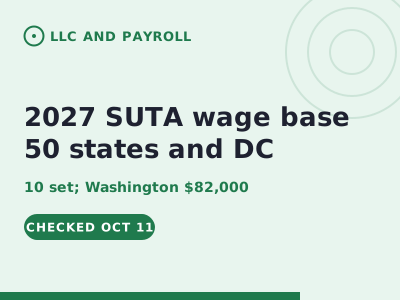
| Washington | 2 1/2 to 3 years | $78,200 | $82,000 | Washington ESD |
| West Virginia | 36 consecutive months | $9,500 | $9,500 (statute) | W. Va. Code 21A-5-5, 21A-1A-28 |
| Wisconsin | not stated | $14,000 | $14,000 | Wisconsin DWD |
| Wyoming | less than three years of experience | $33,800 | $34,900 | Wyoming DWS |
Where published rate lists disagree
Payroll-company tables often give different numbers for the same state. In each case below, the state's own page settles it.
- Alaska, 1.00% or 1.50%. Alaska's 2026 table for new employers lists an employer rate of 1.00%, an employee rate of 0.50% and a total of 1.50% in every industry. The 1.50% figure includes the share withheld from workers' pay.
- Delaware, 1.0% or 1.2%. The Delaware DOL lists 1.0% for new employers in 2026. The 0.2% operations and technology assessment for 2024 through 2026 is charged to each rated employer, and the code says: "“Rated employer” does not include an employer subject to a new employer rate under § 3348 of this title." From 2027 the statute adds a 0.175% assessment for new employers. The old 0.2% supplemental assessment in 19 Del. C. 3348(b)(9) covered calendar years 2004 through 2023.
- New York, 3.4%, 4.025% or 4.1%. "For 2026, the new employer normal contribution rate is 3.4%." The UI rate an employer pays is the normal rate plus the subsidiary rate, 4.025% in total, and the 0.075% Re-employment Service Fund brings it to 4.1%.
- Colorado, 1.53% or 3.05%. 1.53% is the beginning rate alone. With the 0.17% support rate and the 1.35% solvency surcharge, the 2026 combined rate is 3.05%.
- Illinois, 2.80% or 3.35%. IDES says new employers "pay at the entry rate of 3.350%", which includes the 0.550% fund building rate.
- Ohio, 2.7% or 2.85%. ODJFS's 2026 rate details add a 0.15% technology and customer service fee to the 2.7% new business rate.
What we could not confirm
- Arkansas's 2026 rate. The Division of Workforce Services contributions page, read in a browser on 2026-10-17, gives figures only through 2025 (2.0%, made up of 1.9% plus a 0.1% administrative assessment). Its 2023 employer newsletter says Act 196 of 2023 lowered the new employer rate from 2.9% to 1.9% from January 1, 2024. The U.S. Department of Labor's July 2026 Significant Provisions of State UI Laws lists 1.8%; we did not find the change on an Arkansas source.
- Massachusetts's COVID-19 Recovery Assessment rate for new employers. DUA lists it in a separate PDF that we did not read.
- New Hampshire's Trust Fund Reduction for the third and fourth quarters of 2026. The NHES Tax Rate Chart, read on 2026-10-17, lists quarters only through the second quarter of 2026.
- Arizona's own 2026 page (des.az.gov returned HTTP 403). The 2.0% comes from A.R.S. 23-729.
- Kansas's and Nevada's agency pages (HTTP 403). The Kansas figures come from the Kansas Legislative Research Department; the Nevada figures from Nevada's statutes.
- Louisiana's 2026 industry rates. laworks.net disallows automated reading in its robots.txt.
- West Virginia's applied rate after the seven percent reduction that took effect July 1, 2026. We found the statute but no WorkForce West Virginia notice. The DOL's July 2026 summary lists 2.50%.
- Industry-by-industry 2026 rates for Utah, Washington and Wyoming, which we did not find on the agencies' public pages.
- Virginia's 2026 pool cost and fund building charges, and whether Connecticut's 1.0% fund solvency tax is part of its 1.9% rate.
- The year behind Alabama's, Indiana's and South Dakota's rates: their pages give a rate without naming a year.
- Any 2027 new-employer rate beyond the four states above. Most states mail rate notices in December.
Questions
What is the new employer SUI rate by state for 2026?
What is the SUTA rate for 2027?
What is the new employer SUI rate in Colorado?
What is the new employer SUI rate for Florida and Tennessee?
What is the new employer SUI rate in Massachusetts?
This page is general information, not legal or tax advice. The rate a business gets depends on its facts, its industry and each state's rules, and the state's rate notice to the employer is what applies.
Related: 2027 SUI taxable wage bases by state, FUTA credit reduction states for 2026 and new hire reporting by state.
Sources
- Alabama: Workforce Alabama, What is the new account rate? - workforce.alabama.gov; What is the taxable wage base? - workforce.alabama.gov, read 2026-10-17
- Alaska: DOLWD, 2026 rates for new (industry) employers - labor.alaska.gov; tax FAQ - labor.alaska.gov, read 2026-10-17
- Arizona: A.R.S. 23-729 - azleg.gov; A.R.S. 23-622 - azleg.gov, read 2026-10-17
- Arkansas: DWS, Employer UI Contributions - dws.arkansas.gov, read 2026-10-17
- Arkansas: DWS employer newsletter 2023 - dws.arkansas.gov (PDF), read 2026-10-16
- California: EDD, California Employer's Guide DE 44 (2026) - edd.ca.gov (PDF), read 2026-10-16
- Colorado: CDLE, Introductory Rates - cdle.colorado.gov; Premium Rates - cdle.colorado.gov, read 2026-10-17
- Connecticut: CTDOL, tax rate for calendar year 2026 - portal.ct.gov; tax rates and taxable wage base - portal.ct.gov, read 2026-10-16
- Delaware: DOL, employer services and Merit Rate Table - labor.delaware.gov; 19 Del. C. Chapter 33, Subchapter I - delcode.delaware.gov; Subchapter III - delcode.delaware.gov, read 2026-10-17
- District of Columbia: DOES, Tax Rate Questions - does.dc.gov; D.C. Code 51-103 - code.dccouncil.gov, read 2026-10-17
- Florida: Department of Revenue, Reemployment Tax Rate Information - floridarevenue.com; Florida Reemployment Tax - floridarevenue.com, read 2026-10-17
- Georgia: GDOL, employer FAQs - dol.georgia.gov, read 2026-10-16
- Hawaii: DLIR, tax rate schedule - labor.hawaii.gov, read 2026-10-16
- Idaho: IDOL, unemployment tax rates - labor.idaho.gov; 2026 rate class array - labor.idaho.gov (PDF), read 2026-10-16
- Illinois: IDES, EA-50 for 2026 (11/2025) - ides.illinois.gov (PDF), read 2026-10-16
- Indiana: DWD, New Employer Premium Rate - in.gov; Rate Computation - in.gov, read 2026-10-17
- Iowa: IWD, employer handbook, unemployment insurance taxes - workforce.iowa.gov; announcement of June 30, 2026 - workforce.iowa.gov, read 2026-10-17
- Kansas: Kansas Legislative Research Department, Kansas Unemployment Insurance Trust Fund (Aug. 25, 2026) - klrd.gov, read 2026-10-16
- Kentucky: Office of Unemployment Insurance, Employer Guide 2026 - ui.ky.gov (PDF), read 2026-10-17
- Louisiana: La. R.S. 23:1535 - legis.la.gov, read 2026-10-17
- Maine: DOL, 2026 annual rate category/employer array - maine.gov (PDF); employer FAQs - maine.gov, read 2026-10-17
- Maryland: Department of Labor, tax rates and quarterly reporting - labor.maryland.gov, read 2026-10-16
- Massachusetts: DUA, Employer contributions to unemployment - mass.gov, read 2026-10-17
- Massachusetts: M.G.L. c. 151A, section 14 - malegislature.gov, read 2026-10-17
- Michigan: MCL 421.19 - legislature.mi.gov; UIA taxable wage base FAQ - michigan.gov, read 2026-10-17
- Minnesota: UI, 2026 new employer tax rates - uimn.org; tax rates - uimn.org, read 2026-10-17
- Mississippi: MDES, employer FAQs - mdes.ms.gov, read 2026-10-16
- Missouri: DES, tax rates - labor.mo.gov, read 2026-10-16
- Montana: DLI, 2026 taxable wage base and rates - dli.mt.gov (PDF), read 2026-10-17
- Nebraska: DOL, combined tax rates - dol.nebraska.gov, read 2026-10-16
- Nevada: NRS Chapter 612 - leg.state.nv.us, read 2026-10-17; DETR Research and Analysis Bureau memo of June 1, 2026 - nevadaworkforce.com (PDF), read 2026-10-11
- New Hampshire: NHES, Tax Rate Frequently Asked Questions - nhes.nh.gov, read 2026-10-17
- New Hampshire: NHES, Tax Rate Chart - nhes.nh.gov, read 2026-10-17
- New Hampshire: RSA Chapter 282-A - gc.nh.gov, read 2026-10-17
- New Jersey: NJDOL, rate information, contributions and due dates - nj.gov, read 2026-10-16
- New Mexico: NMDWS, how UI tax rates are calculated - dws.nm.gov; UI tax information - dws.nm.gov, read 2026-10-17
- New York: NYSDOL, unemployment insurance rate information - dol.ny.gov, read 2026-10-17; Publication NYS-50 - tax.ny.gov, read 2026-10-16
- North Carolina: DES, tax rate information - des.nc.gov, read 2026-10-16
- North Dakota: Job Service North Dakota, 2026 tax rate schedules - jobsnd.com (PDF); learn about taxes - jobsnd.com, read 2026-10-16
- Ohio: ODJFS, 2026 rate details - ohio.gov (PDF), read 2026-10-17
- Oklahoma: OESC, Important Numbers for 2027 - oklahoma.gov (PDF), and for 2026 - oklahoma.gov (PDF), read 2026-10-11
- Oregon: Employment Department, 2026 tax rate press release of Nov. 18, 2025 - oregon.gov (PDF), read 2026-10-17
- Pennsylvania: Department of Labor and Industry, Yearly Tax Highlights - pa.gov, read 2026-10-17
- Rhode Island: DLT, Employer Tax Unit - dlt.ri.gov, read 2026-10-17
- South Carolina: DEW, tax rate information - dew.sc.gov, read 2026-10-17
- South Dakota: DLR, reemployment assistance for businesses - dlr.sd.gov, read 2026-10-16
- Tennessee: TDLWD, instructions for Report to Determine Status - lwdsupport.tn.gov, read 2026-10-17; UI tax rates - tn.gov, read 2026-10-16
- Texas: TWC, New Texas Employer Information - twc.texas.gov, read 2026-10-17
- Utah: DWS, tax rates - jobs.utah.gov, read 2026-10-16
- Vermont: DOL, unemployment tax rates - labor.vermont.gov, read 2026-10-17; release of Oct. 6, 2025 on the 2026 wage base - labor.vermont.gov, read 2026-10-16
- Virginia: VEC, How are tax rates assigned? - vec.virginia.gov; What factors determine my tax rate? - vec.virginia.gov, read 2026-10-17; Code of Virginia 60.2-229 - law.lis.virginia.gov, read 2026-10-11
- Washington: ESD, how we determine tax rates - esd.wa.gov, read 2026-10-17; news release of June 10, 2026 - esd.wa.gov, read 2026-10-11
- West Virginia: W. Va. Code 21A-5-5 - code.wvlegislature.gov; enrolled SB 1053 (2026) - wvlegislature.gov, read 2026-10-17; W. Va. Code 21A-1A-28 - code.wvlegislature.gov, read 2026-10-11
- Wisconsin: DWD, 2027 tax rates - dwd.wisconsin.gov, read 2026-10-17
- Wyoming: DWS, unemployment tax rates - dws.wyo.gov, read 2026-10-17; unemployment taxable wage base - dws.wyo.gov, read 2026-10-11
- Wage bases fixed in statute: Florida Statutes 443.1217 - leg.state.fl.us; Kentucky Revised Statutes 341.030 - legislature.ky.gov; Ohio Revised Code 4141.01 - codes.ohio.gov; South Carolina Code, Title 41, Chapter 27 - scstatehouse.gov, read 2026-10-11
- U.S. Department of Labor, Significant Provisions of State UI Laws, July 2026 - oui.doleta.gov (PDF), read 2026-10-17, and January 2026 - oui.doleta.gov (PDF), read 2026-10-11. The DOL describes this summary as "not an official interpretation of state UI laws"; we use it only where a state's own site could not be read.
Source links are not affiliate links. This page is general information, not legal, tax or financial advice.